

Rockfield Studios
Amberley Court, Rockfield Road, Monmouth
Rockfield Studios is one of only a few surviving independent recording studios from the sixties, and probably the only one that is still in its original location and under the same ownership. It was, and still is, a family-run business with a simple philosophy: a great location that has always provided the right environment to record live musicians.
History
It was set up by brothers Charles Ward and Kingsley Ward in 1964 on their family farm in Wales. The brothers started out as musicians, playing the pubs and clubs of Wales in the early sixties. They soon found themselves with a recording deal and travelling to London, where they met Joe Meek and briefly worked in his studio flat, recording and engineering.
Their trips to London had demystified the recording process and they realised they could record themselves, as long as they had the necessary equipment. This led to the idea of setting up their own studio back home in Wales and a philosophy of “we’ll do it ourselves, our own way”. That independent approach would remain largely unchanged over the coming decades and lead not only to the studio’s survival..— when most of its London competitors had fallen by the wayside — but also to a fantastic catalogue of recordings spanning six decades that would be the envy of most studios.


It started as a small demo studio in the main farmhouse attic equipped with a Rosser desk, a Ferrograph tape machine (followed by a Philips valve two-track) and a few bits of outboard.
By 1965, accommodation was provided so the studio could give itself the official title of ‘residential’.
It was also named ‘Future Sounds Ltd, not Rockfield!
“I name this studio... Rockfield”
The studios gradually became known as ‘Rockfield’ in the late 1960s, when Dave Edmunds pointed out the fact that the local village name was perhaps perfect as a studio name. It was such an obvious and fitting title that nobody could understand why it had not been thought of before.
Dave Edmunds would provide a second essential landmark in the history of the studios a few years later.

Rosser Desks
In the same year they had a new mixing console built again by Rosser Electronics of Swansea. Formed in 1967 by Douglas Rosser and Dafydd Evans, Rosser Electronics was set up in Swansea, Wales to supply audio equipment to commercial TV and broadcast stations. In 1972 when NATO fitted out its headquarters in Brussels with 9 studios for broadcast and communications equipment, the contract was carried out by Rosser electronics. They had also built a custom mixing desk for Mayfair Studios in London before building the first for Rockfield.
These Rosser desks would help provide the trade mark sound of the studios in the coming years.
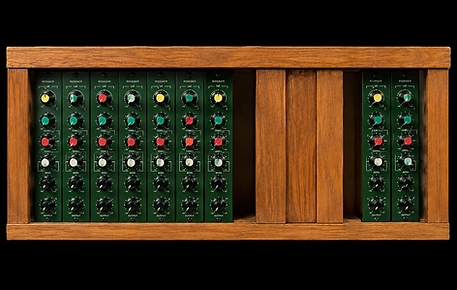
Even after the desks were eventually replaced, two sets of the mic pre/EQ modules were kept and racked up so their distinctive sound could still be used for track laying.

Rosser Modules
These Rosser desks would help provide the trade mark sound of the studios in the coming years.
Even after the desks were eventually replaced, two sets of the mic pre/EQ modules were kept and racked up so their distinctive sound could still be used for track laying.

The Coach House 1968
By 1968, the studio had moved into an extension built using a former stable block next to the farmhouse. This was called The Coach House.
They added a second EMI TR90 two-track tape machine, plus more outboard gear and an EMT echo plate.
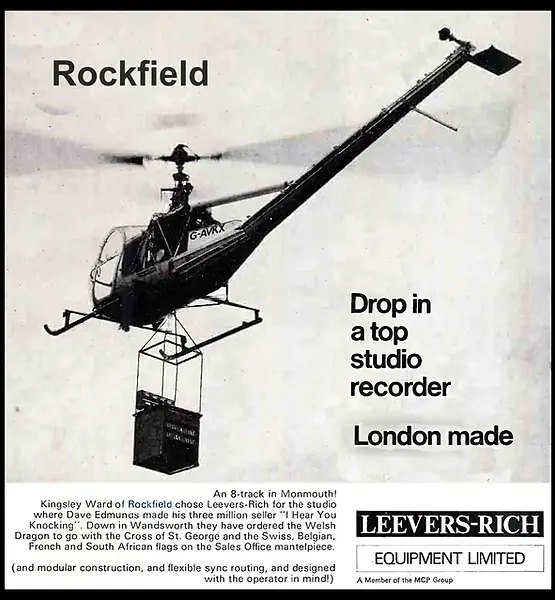
In 1968 they became 8-track with the purchase of a Leevers-Rich tape machine.

“They were brilliant sounding. Some of the greatest recordings in the world were made using them even though most people today have never heard of them. Bohemian Rhapsody, Rush’s A Farewell To Kings – they were all done using Rosser modules and we’ve got eight of them available now in each studio”. Kingsley Ward.
“In the smaller studio, The Coach House,...they have a [48-channel] Neve 8124 and Rosser mic pres, which came from the Rosser desk on which I recorded Bohemian Rhapsody".
Roy Thomas Baker
The First Big Hit - 1969
In 1969, Dave Edmunds discovered a local band called Shakin' Stevens and the Sunsets and took on the production role to record their first album, A Legend, for Parlophone Records at Rockfield. The album included a cover version of the Smiley Lewis track I Hear You Knocking.
In 1970, Dave Edmunds would produce his own version of I Hear You Knockin' and bring about the second important milestone in Rockfield’s history — a number one hit single. Featuring the famous vocal recorded through a telephone line, it became a massive hit, reaching the top ten in both America and England.
The success of the single firmly established Rockfield as a serious professional recording studio and gave it the credibility needed to attract the attention of the London music industry.”

Dave Edmonds in the control room at Rockfield
In 1971 the studios became 16-track.
In 1972 they set up the Rockfield record label, initially to release Dave Edmunds’ future recordings. They scored two hit singles in 1972 and 1973 with Baby I Love You (No. 8) and Born to Be with You (No. 5).

The Quadrangle - 1973
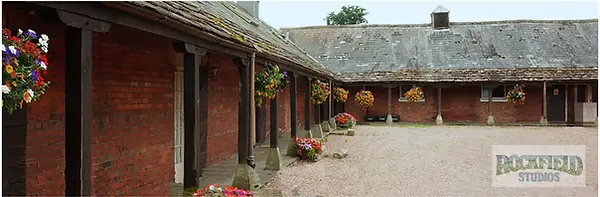
A second studio was added in 1973 called The Quadrangle, built in what had been the old stables and agricultural buildings surrounding the courtyard. It saw Rockfield become a 24-track studio with the inclusion of a Studer tape machine and another Rosser console. With the amount of floor space available, The Quadrangle would feature a number of different acoustic spaces that became popular with rock bands and producers alike over the coming years.

Queen at Rockfield - 1974
In June 1974, Queen used the studios for sessions on the album Sheer Heart Attack. This was the first time the band had recorded outside London.
The recording sessions used both The Coach House and Quadrangle studios, and by the end of the month, backing tracks for ten of the thirteen songs that would appear on the album had been recorded.
The following year, after the rigours of an American tour, they reconvened there with producer Roy Thomas Baker to start writing and recording their most famous work — one that would ensure Rockfield’s legacy in rock history for decades to come.

Bohemian Rhapsody

On August 24th 1975, Queen returned to Rockfield to begin recording the album A Night at the Opera, including the basic backing tracks for the three main sections of Bohemian Rhapsody. Both Sheer Heart Attack and A Night at the Opera had their basic backing tracks recorded using the Rosser desks and Studer tape machines. The piano used for the track is still at Rockfield.
One night during these sessions, the band were watching an old favourite Marx Brothers film and the title seemed fitting for their new release.
Queen at Rockfield
“There was a room at Rockfield full of saddle bags. It was one of the many rooms we used to hide ourselves away in individually to get away from the studio — to clear our heads and re-energise our batteries. So if people wanted to hide away, there were loads of these little rooms full of saddle bags and farm-type things. I remember Freddie playing me Bohemian Rhapsody for the first time on his piano at his place in London. Then later at Rockfield, with the basics mapped out, he focused on pinning down what was right. He played me the beginning part and said, ‘Right, now this is where the opera section comes in,’ and he’d leave a gap and I’d have to imagine this dramatic opera-style segment. And it just kept changing all the time at Rockfield. It took three weeks to record on a 16-track tape machine.” — Roy Thomas Baker


By 1974 the studio could boast an addition that Abbey Road could never match - a 2,000ft landing strip for light aircraft.
In 1976 the desk in The Quadrangle was upgraded to a Rosser 42/24 and Allison automation was added. The Coach House studio was still 16-track at this point.
A Farewell to Kings - 1977
Rush’s time at Rockfield Studios in Monmouthshire, Wales, is considered one of the most pivotal periods in the band’s history. They recorded two of their most iconic albums there: A Farewell to Kings (1977) and Hemispheres (1978).
'So we pulled into Rockfield, and we thought - what is this? What are we doing here? It's a stud farm -there aren't any paved roads or anything - and we were really kind of put off when we first got there. But once we got into the studio and into the feel of the whole place - musically and visually - it really clicked.'

Rockfield provided the space for the band to experiment. Geddy Lee began using Moog synthesizers and bass pedals extensively, while Neil Peart expanded his percussion kit to include orchestral bells, tubular bells, and woodblocks to suit the "fantasy" themes of the songs.
Before 1977, Rush had recorded primarily in Toronto. However, they wanted to capture the "English sound" of their prog-rock heroes like Yes, Genesis, and Led Zeppelin.
The Outdoor Sound: To get the natural reverb heard at the beginning of the title track "A Farewell to Kings," Geddy Lee and Alex Lifeson recorded their acoustic guitars outside in the courtyard. You can actually hear the Welsh birds chirping in the background of the intro.
While they eventually moved to Le Studio in Quebec (often called "the Canadian Rockfield") for Permanent Waves and Moving Pictures, the band always spoke fondly of Wales. They credited Rockfield with giving them the isolation and professional environment they needed to prove they were more than just a "Led Zeppelin clone" and were, in fact, masters of progressive rock.
Change to Trident Desks - 1978
In 1978 the studio changed from the Rosser desks to two Trident TSMs, one of which is seen here with producer Roger Bechirian and artist Robert Ellis Orrall.

The Era of Punk and New Wave
The late 1970s were difficult times for most studios as recording budgets were being slashed by record companies. Many of the London facilities had followed the latest trends in equipment and acoustic design, resulting in many ‘state of the art’ studios — impressive in presentation but virtually indistinguishable from each other in sound and often appearance. Much of the individual character that had given these places their reputations had been lost. Rockfield managed to remain outside this trend, partly due to its location but also because of a continuity in ownership and philosophy.

The Skids at Rockfield - 1979
“Rockfield was developed by converting redundant farm buildings without the help of any design consultants,” recalls Kingsley Ward. “We have always relied on our own ability for acoustics. To this day, Rockfield relies on natural acoustics to capture the sound of musicians.”
Although the reputation of the studio had been built primarily on rock music, the place adapted easily to the post-punk and new wave era at the beginning of the 1980s. Rockfield had always retained a reputation as an exciting and creative place to record, and that atmosphere never really changed over the years despite many of this next generation of musicians outwardly rejecting many of the great bands and albums that had been recorded there.

Adam and the Ants recorded their landmark second album, Kings of the Wild Frontier, at Rockfield in August 1980.
For Liverpool bands — and many Northern bands alike — including Echo & the Bunnymen and The Teardrop Explodes, Rockfield had the feel of being a local studio even though it was over 160 miles away. Rather than travelling to a clinical — and often intimidating — London studio, it felt more like going off on an adventure to a summer camp for a working holiday.

Echo and The Bunnymen - 1982

Change to Neve Desks
At the end of the 1980s the Trident TSMs were replaced with Neve VR consoles (the first VR to be built went to Rockfield) and both studios had Studer A820 24-tracks with Dolby SR. There was also an extensive list of outboard gear from AMS, Klark Teknik, Yamaha, TC Electronic, Tube-Tech, Drawmer, Orban, Eventide and others. The microphone collection included some classic vintage Neumanns — two U67s, five SM2 stereo microphones and two KM56s. The main monitors were JBL 4350s.
By the mid 1990s Rockfield had already survived three decades of enormous change within the recording industry. Many of the great independent studios of the 1960s and 70s had either disappeared altogether or become heavily modernised corporate facilities. Rockfield, however, had remained largely true to the same philosophy it had started with in 1964 — live rooms with character, residential recording and enough isolation from the music business to allow bands to properly focus on making records.
Over a twelve-month spell in 1996/97 they had five number one albums from Oasis, Black Grape, The Charlatans, The Boo Radleys and Ash.

Oasis at Rockfield Studios
In the summer of 1995 Oasis arrived at Rockfield to begin work on what would become (What's the Story) Morning Glory? with producer Owen Morris. The band had already achieved major success with Definitely Maybe the previous year, but the atmosphere surrounding these sessions was very different. Expectations were now enormous and Oasis were rapidly becoming the biggest British band of the decade.
Rockfield suited the group perfectly. The residential setup allowed the band to live and work entirely within the same environment, away from London distractions and record company interference. The rural surroundings also matched the working-class Northern attitude that had always fitted naturally into Rockfield’s history. Like many bands before them — from Echo & the Bunnymen to Queen — Oasis found themselves in a place where the studio felt less like a business and more like a world of its own.
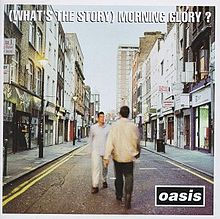
What's the Story Morning Glory
A large part of the album was recorded in The Quadrangle using the Neve VR console and the Studer analogue tape machines. Although digital recording was rapidly becoming the industry standard by the mid 1990s, Rockfield still maintained a strongly analogue approach and this became an important part of the sound of the record. The huge drums, dense guitars and aggressive compression that characterised the album worked particularly well within the natural acoustics of the studio rooms.
During the sessions Noel Gallagher continued writing material at a remarkable pace. Songs such as Wonderwall, Don't Look Back in Anger, Champagne Supernova and Some Might Say would become defining recordings of the Britpop era and help turn the album into one of the biggest-selling British records of all time
The atmosphere during the recording could swing between highly productive and completely chaotic. Stories from the sessions include late-night arguments, heavy drinking and the increasingly volatile relationship between brothers Noel Gallagher and Liam Gallagher. Yet this unpredictability often seemed to feed directly into the energy of the recordings. Rockfield had always been a place where bands were given enough freedom to either flourish creatively or self-destruct trying, and Oasis fitted naturally into that tradition.

The album’s success also helped re-establish Rockfield as one of the premier rock recording studios in Britain at a time when many traditional studios were struggling to survive. Over the following years artists including The Charlatans, Ash, Black Grape and Coldplay would all record there, continuing Rockfield’s long reputation as a studio where major British guitar records seemed naturally at home.
MCI and Neve Desks
In 2003 the Neve VR60s were replaced by an MCI 500 with extra Neve EQs in The Quadrangle and a Neve 8128 rebuilt with extra Neve 1061 and API 500 series modules in the Coach House. One of the old Rosser desks had 16 of the channels removed and eight racked in each of the studios in acknowledgement of how great these desks really were.
In the Quadrangle there’s an old [82-input] MCI 500, which was the same desk on which I mixed the Jazz album with Queen. Both studios also have several Neve 1060/1 mic pres and API 550 EQs, and each has two Studer 24-track recorders.”
RoyThomas Baker.

“We realised not just these shortcomings but also that, with the onset of Pro Tools, large automated consoles were no longer as desirable to clients and we needed to change once more. Smaller vintage consoles were easier to maintain, cheaper to run, didn’t depreciate and, more important, sounded better, so we reinvented ourselves once again by going backwards and installing a 48-track Neve 8128 in the Coach House Studio and an MCI 500 Series in The Quadrangle Studio — a move that we have never regretted.”
— Kingsley Ward
The courtyard was also used to record the local birds for Xanadu on the album A Farewell to Kings. Legend also tells the story of how Freddie Mercury came up with the last line to Bohemian Rhapsody — “Any way the wind blows” — whilst sitting at the piano and watching a weather vane spinning around outside his window.
In later years, a young bass player was standing outside in the courtyard one night, looking up at the clear night sky. He went back inside and said to the others:
“Look at the stars, look how they shine.”
“A big part of the success of the studios is the creative environment provided by being on a farm in the middle of the countryside. In the wild days of 1970s rock and roll, bands were free — and far enough away from normal civilisation and record company executives — to indulge in the various antics required of any self-respecting rock band of the day”. - Kingsley Ward
Where To Next?

Side door if you're recording with Brian Eno. Front door if you are here for the bingo.

Our own Tony Harris tells us
about the studio where he
worked for many years.

A small independent demo studio that became a focal point for a new generation of British pop artists.

Keith Andrews was an integral part of the studios for many years and here he takes us through its history and development

Often in the shade of Abbey Road but at the top for developments in recorded sound.

The amazing home and studio of John and Yoko where they recorded Imagine.